
Pay for Trade School Without Letting the Monthly Payment Hide the Total Cost
The short answer
Verify that the training supports the job or credential you want, add all costs of attending, then compare funding and repayment options. An affordable-looking monthly loan payment cannot make an unrecognized program or an unrealistic work schedule a good investment.
The FTC recommends checking program credentials, costs, completion and job-placement claims before enrolling in vocational education. Verify claims with independent sources and the relevant licensing authority or employers, not only the school's recruiter. FTC vocational-school guidance.
Define the outcome and confirm the route
Write the occupation, required credential if any and the employers or work settings you are targeting. Ask whether the program actually meets the applicable education or licensing requirement. Accreditation, certification and state authorization answer different questions; do not treat one label as proof of all three.
Compare community-college, apprenticeship, employer-funded and other legitimate routes where available. The lowest tuition is not automatically the best fit if the schedule is impossible, but a more expensive program should have a clear reason beyond a sales promise.
Build the full attendance budget
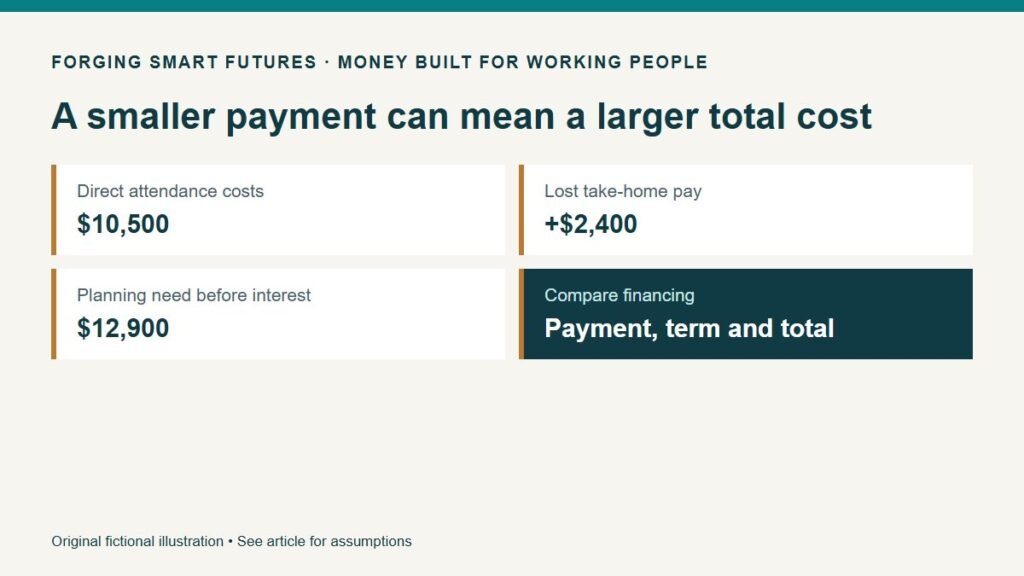
In a fictional program, tuition is $8,000, tools cost $1,200, exams and licensing-related fees are estimated at $400 and added travel costs $900. Those direct costs total $10,500.
If the schedule reduces take-home pay by $300 monthly for eight months, another $2,400 of household cash support is needed. The combined planning amount is $12,900 before interest, unexpected costs or any verified aid.
Keep the lost-pay estimate separate from school charges so it is not mistaken for tuition eligible for a particular funding program. Confirm tools, uniforms, retakes, deposits, refund policies and any costs due before aid disbursement.
Ask what the outcome statistics mean
When a school gives a placement rate, ask which students are counted, the period measured, whether jobs are in the field and whether results are independently verified. Ask about completion rates and the consequences of stopping partway through.
Talk with relevant employers about the training they recognize. A national salary figure does not establish local entry pay, available shifts or the chance of getting hired. Do not build repayment around the highest advertised earnings.
Compare financing over the whole repayment period
Suppose a fictional $10,000 loan has a fixed 10% annual nominal interest rate, monthly payments, no fees and a sixty-month term. The calculated payment is about $212.47, with total scheduled payments about $12,748 using the unrounded formula before payment-rounding adjustments.
Extending the same assumptions to 120 months lowers the calculated payment to about $132.15 but raises total payments to about $15,858. The smaller monthly bill costs roughly $3,110 more over the full term under these assumptions.
Actual education loans may have different fees, interest accrual, repayment start dates and protections. Compare the written disclosures and applicable program rules. A quoted payment without the amount financed, rate and term is not enough.
Stress-test the job transition
What if hiring takes three months after completion? What if initial take-home improvement is $200 monthly rather than $500? What if a required exam must be retaken? These questions do not mean the training lacks value; they show how much uncertainty the household must carry.
Compare repayment with ordinary expected income and existing bills. Keep grants, scholarships and employer assistance separate from loans, and verify any service or repayment conditions on employer funding.
Your next action
Request the total-cost schedule, refund terms and outcome definitions in writing. Build the attendance cash plan before signing financing documents. Use the FSF cost-of-going-to-work guide and variable-pay budget. Existing free and member resources are labeled on the Resources page.
General education, not individualized education, lending, legal or financial advice. All tuition, earnings and loan figures are fictional. No school, job outcome or affiliate relationship is endorsed.
Editorial attribution: Paul Foster
Published: September 10, 2026 Last reviewed: September 10, 2026
Sources & References
- https://consumer.ftc.gov/articles/choosing-vocational-school-or-certificate-program
Put this into practice
Compare the full commitment against a lower-income month. Free Major Financial Decisions checklist — no membership required.
Related decisions
- Returning to Work After Caregiving: Budget the Gap Before the First Paycheck
- What Going to Work Really Costs Your Household
- Why Your Overtime Check Is Smaller Than the Number in Your Head
Expanded member resource: Big Purchase and Household Decision Workbook. Guided exercises with local save, reopen and print controls. Worksheet answers are not automatically calculated. Compare free resources and FSF membership benefits.
Human-reviewed, AI-assisted content; how FSF creates articles.