
Stop Letting Tires and Work Boots Become Financial Emergencies
Irregular does not always mean unexpected
The truck will need tires eventually. Work boots wear out. An insurance renewal can arrive every six months even though most bills arrive monthly. These costs can feel like emergencies when the ordinary budget gives them no place.
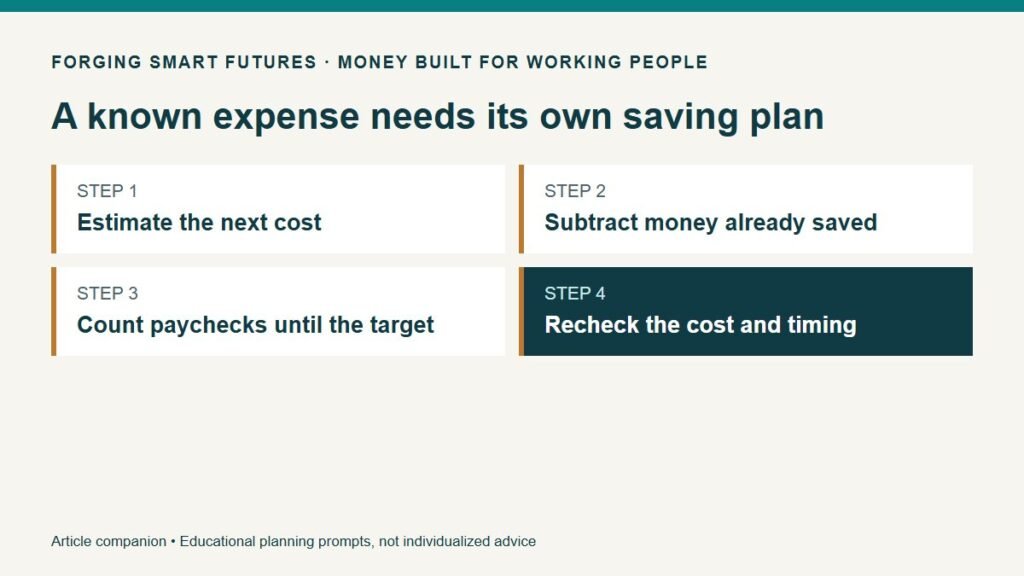
A known-bill reserve is money assigned to a cost you expect, even if its exact amount or date is uncertain. Start with the best available estimate, subtract money already assigned, and divide the remaining amount across the paychecks you expect before you need it.
The CFPB recommends looking back over several months for less frequent expenses when assessing spending. FSF's examples below apply that idea to working households. CFPB: Assess your spending.
Make a list from evidence, not a perfect-memory exercise
Look through receipts, account transactions and renewal notices. Ask what allowed you to keep working last year: reliable transport, required clothing, professional renewals, tools you are responsible for, and household arrangements that support your schedule.
Do not assume every work-related purchase is your responsibility. Check employer policies, any reimbursement process and the actual requirement before buying. The reserve worksheet does not decide whether an employer must provide an item or whether a purchase receives special tax treatment.
For each cost, record the item, expected amount, target date, money already assigned and the evidence behind the estimate. A current quote is different from last year's receipt. Keep the distinction visible.
Divide by the paychecks left, not automatically by twelve
Taylor, a fictional technician, wants to model a $720 tire purchase four months away. There is $120 already assigned to tires. Taylor expects eight paychecks before the target date.
The calculation is ($720 − $120) ÷ 8 = $75 per paycheck.
Dividing $720 by twelve would produce $60 per month. That annual average would not fund this particular purchase in four months. It answers a different question.
Taylor also models $180 for boots in three months, with $60 already assigned and six paychecks remaining. The contribution is ($180 − $60) ÷ 6 = $20 per paycheck.
| Item | Estimated cost | Assigned cash | Paychecks before target | Contribution per paycheck |
|---|---|---|---|---|
| Tires | $720 | $120 | 8 | $75 |
| Boots | $180 | $60 | 6 | $20 |
| Combined while both goals are active | — | — | — | $95 |
These are invented amounts, not current market prices or product recommendations. Real costs depend on the item, required specification and local availability.
Put the contribution inside the paycheck plan
The $95 is not extra income. It competes with other uses of the same deposit. Before transferring it, check bills and necessary spending through the following payday.
If Taylor can assign only $55 from a particular deposit, the record should show $55. The remaining shortfall still exists. Future contributions, the target date or the cost estimate must change; changing the worksheet's label does not fund the purchase.
For overtime income, decide on a contribution only after the deposit arrives and the next bill cycle is accounted for. A reserve plan that depends on overtime every period should say so explicitly.
Avoid counting one dollar in two places
Suppose Taylor's savings account holds $1,400. Of that, $300 is assigned to tires, $100 to boots and $1,000 to an emergency reserve. The account contains $1,400, but the emergency reserve contains $1,000.
You can track these assignments in a simple table; this arithmetic does not require opening three accounts. If you do use separate accounts or software categories, verify fees and transfer timing rather than assuming the labels make the money more accessible.
When the tire purchase happens, subtract it from the tire reserve. Do not also classify the earlier savings transfers as final spending in a report that already counts the purchase. A transfer moves your money; the later purchase is the outflow to the seller. Different budgeting tools display this differently, so check your method for double-counting.
Keep the date uncertain when the date is uncertain
An insurance notice may provide an exact renewal date. A tire replacement estimate may depend on condition and use. Do not turn a planning date into a safety assessment. Follow appropriate inspection and maintenance guidance for the actual equipment or vehicle.
If a necessary repair becomes urgent before the reserve is ready, update the plan to show the real timing. A reserve can reduce the surprise of a cost; it cannot guarantee that equipment lasts until your chosen month.
Likewise, avoid treating an estimated purchase as an automatic payment instruction. A calendar reminder should prompt you to inspect the estimate, check the assigned balance and make the next decision.
Reset the reserve after using it
Once the purchase is complete, record its actual amount and date. Keep the receipt. If money remains, decide whether to retain it for the next replacement or assign it elsewhere. Do not let an old target silently accumulate forever.
A useful review record has four entries: original estimate, actual cost, difference and what you learned. Perhaps the estimate omitted installation. Perhaps the employer reimbursed part of the purchase. Perhaps the item lasted longer than expected. Use that evidence for the next cycle.
Start with the next two costs
You do not need a twenty-category worksheet tonight. Pick two predictable costs likely to arrive in the next several months. Find an amount and date estimate. Count actual remaining paydays, calculate the contribution, and test it against your current bill calendar.
Review after each paycheck and whenever the amount or deadline changes. Keep the emergency reserve separate in your records so you can see what is truly available for an unplanned disruption.
Use the FSF Variable Pay Budget Planner to include known-bill reserves in a monthly scenario. For a different problem—income that might disappear—read Emergency Savings When Your Hours Can Be Cut.
Financial-education disclaimer: General education only, not individualized financial, investment, tax, legal or credit advice. Examples are fictional. This worksheet does not establish employer obligations, tax deductibility, equipment condition or safe replacement intervals.
Source checked September 8, 2026: CFPB spending guidance linked above. Reserve calculations and Taylor examples are original FSF illustrations.
Editorial review: Owner reviewed and approved this article for release on September 9, 2026. Prepared with AI assistance by FSF Editorial Team; no professional adviser review is claimed.
Editorial attribution: Paul Foster
Published: September 9, 2026
Sources & References
- https://www.consumerfinance.gov/owning-a-home/prepare/assess-your-spending/
- https://forgingsmartfutures.com/variable-pay-budget-planner/
- https://forgingsmartfutures.com/emergency-savings-hours-cut/
Put this into practice
Separate true surprises from bills you can see coming. Free Saving checklist — no membership required.
Related decisions
- Tool Rental or Purchase for a Side Job? Compare the Break-Even Point
- When a Five-Week Month Breaks Your Grocery and Fuel Budget
- How to Compare Savings Accounts for Your Emergency Fund
Expanded member resource: Cash Cushion and Planned Expenses Workbook. Guided exercises with local save, reopen and print controls. Worksheet answers are not automatically calculated. Compare free resources and FSF membership benefits.
Human-reviewed, AI-assisted content; how FSF creates articles.