
Tool Rental or Purchase for a Side Job? Compare the Break-Even Point
The short answer
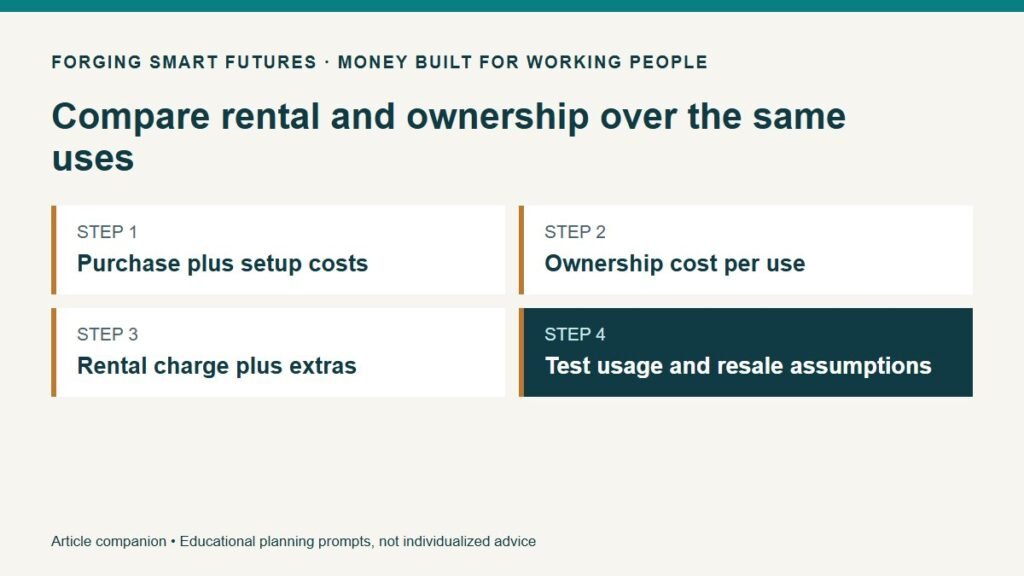
Compare the total cost of using the same tool for the same work, over a defined number of uses. Include purchase setup, maintenance, rental extras and a cautious resale assumption. Then check the cash needed today and the uncertainty of future jobs. A calculated break-even point does not guarantee enough work to reach it.
This article compares a simplified cash-cost scenario. It does not calculate financing, taxes, depreciation or whether the tool is suitable for a particular task.
Make the two options comparable
Check that each option can perform the same work and includes the accessories, transport and support you need. A bare rental quote may omit charges that matter. A purchase price may leave out setup, storage or maintenance equipment.
Define a “use.” It might mean one job, one day or one rental period. Keep that definition consistent. If one customer job spans three rental days, comparing a one-day rental price with one purchased-tool job understates rental cost.
Get current terms for the actual equipment. Ask about delivery, return deadlines, damage responsibility and additional charges. This article does not interpret a rental contract; use the written terms to build the figures.
A fictional twelve-use comparison
Assume the following illustrative amounts:
| Input | Amount |
|---|---|
| Purchase price | $1,000 |
| One-time setup and transport | $100 |
| Owned-tool cost per use | $10 |
| Rental charge per use | $75 |
| Rental extras per use | $15 |
| Assumed resale at comparison end | $0 |
Buying requires $1,100 upfront in this example. At twelve uses, ownership cost is $1,100 plus $120, or $1,220. Rental costs $90 per use, or $1,080. Renting is $140 lower over that particular twelve-use period.
The figures are invented to explain the method, not market quotes or a recommendation to rent a specific tool.
Find the threshold
Each use costs $90 when renting and $10 when owning, a difference of $80. Recovering the $1,100 fixed purchase/setup cost requires $1,100 ÷ $80 = 13.75 uses. Because this example counts whole uses, ownership is no more expensive beginning at fourteen uses under unchanged assumptions.
At fourteen uses, ownership totals $1,240 and rental totals $1,260. The $20 difference confirms the threshold. It is a small modeled advantage that could easily be changed by an omitted charge or unexpected repair.
The general simplified calculation is fixed ownership cost, net of assumed eventual resale, divided by rental cost per use minus owned cost per use. If rental cost per use is no greater than owned cost per use and fixed ownership cost is positive, increasing use does not create a break-even in favor of ownership under this model.
Treat resale as a scenario, not upfront funding
If you assume $300 resale, the example's fixed cost falls to $800 for the comparison. The threshold becomes ten uses. But you still need $1,100 to purchase and set up the tool today.
Future resale depends on condition, market demand, selling costs and whether you actually sell. Run a zero-resale case alongside any estimate. Do not treat a hoped-for resale amount as cash available for this week's household bills.
Likewise, if you already own the tool, the decision is different. The historical purchase price is not a new cash payment today. You would need to compare the costs and alternatives relevant now, including maintenance and what giving up the tool would mean. Do not force that decision into a buy-new model.
Ask whether the uses are real
List confirmed jobs separately from inquiries and possible future work. Fourteen imagined uses are not equivalent to fourteen booked jobs. Consider the period required to reach them and whether the equipment could become unsuitable or need maintenance before then.
A purchase can also affect the services you feel pressured to sell. If the only way to justify it is to assume more work than your schedule supports, revisit the capacity estimate. Rental may carry inconvenience and availability risk, but ownership carries fixed commitment and storage responsibilities.
The SBA's planning guidance emphasizes understanding business costs and funding needs. Use that as background; this break-even model is an original FSF illustration. SBA business planning.
Check today's cash before choosing the lower modeled cost
Even when buying appears cheaper over many uses, the upfront payment may create a cash gap before customers pay. Keep enough detail to see both the long-period comparison and the actual payment schedule.
Use the FSF startup-cost guide for the initial funding picture and the cash-timing guide for payment timing. Write the assumptions beside the decision and review them after actual jobs. The useful result is an equipment choice supported by evidence about cost, cash and work you can realistically perform.
General education only, not individualized financial, investment, tax, legal or credit advice. Examples are fictional and depend on the stated assumptions. Prepared with AI assistance by FSF Editorial Team; reviewed for publication by the FSF publisher.
Editorial attribution: Paul Foster
Published: September 10, 2026 Last reviewed: September 10, 2026
Sources & References
Put this into practice
Find out what a job earns after costs and all your time. Free Side Income checklist — no membership required.
Related decisions
- How to Price a Weekend Job Without Forgetting Your Costs
- What Will It Cost to Start Your Service Business Before the First Customer?
- Separate Side-Gig Money From Household Bills Without Building a Complicated System
Expanded member resource: Side-Gig Profit and Pricing Workbook. Guided exercises with local save, reopen and print controls. Worksheet answers are not automatically calculated. Compare free resources and FSF membership benefits.
Human-reviewed, AI-assisted content; how FSF creates articles.