
How to Read Your 401(k) Match When Your Pay Includes Overtime
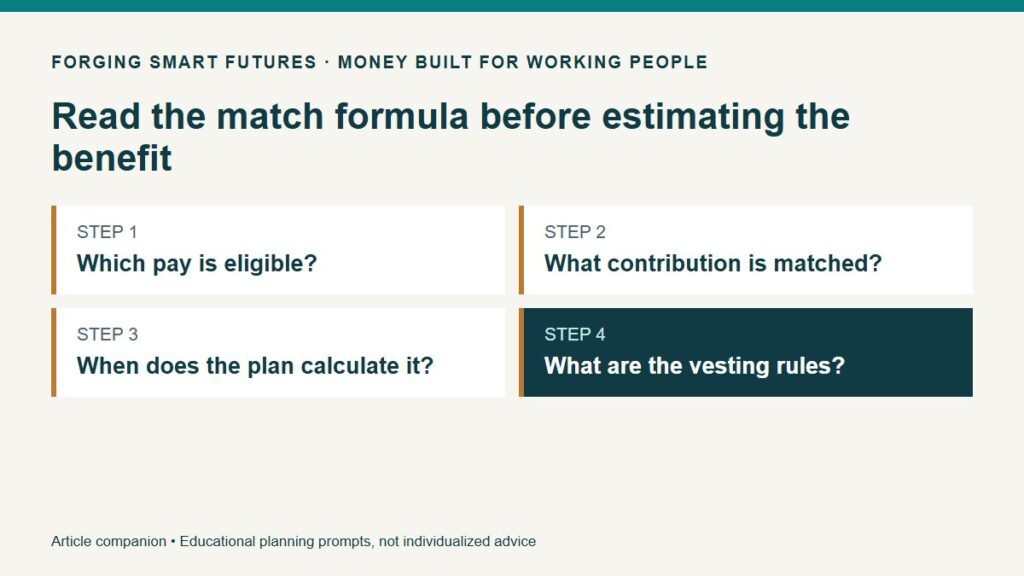
The match percentage is only part of the answer
A benefits summary that says your employer matches part of your contribution may leave you with a practical question: part of which pay? If your paycheck contains regular wages, overtime, a shift differential or a bonus, the answer matters when you estimate retirement contributions and money available for bills.
Start with the plan's definitions and the calculation period. Then apply the matching formula to the appropriate pay and contribution. Do not assume the gross-pay number on your statement is automatically the number used for every retirement-plan purpose.
The IRS explains that a plan can use different definitions of compensation for deferrals, allocations and testing. Its guidance specifically discusses overtime and the need to follow plan terms and applicable rules. That is a reason to ask the administrator for a clear calculation, not to decide that every overtime exclusion is either permitted or an error. IRS compensation definition guidance.
Collect the documents before reaching for a calculator
Find your current benefits summary, the plan's summary plan description and any relevant updates, your contribution election and a recent paycheck statement. If the summary does not answer a question, ask the plan administrator which provision controls and request an explanation for your situation.
Write the date of each document beside the information you use. An old enrollment flyer and a current payroll portal can describe different periods. Do not combine their figures into a confident answer until you know which applies.
Keep private statements private. You can ask general questions without posting an unredacted paycheck or retirement account screenshot in a work group chat or an AI tool.
Ask six specific questions
Use this as a call or message outline for the plan administrator:
- Which pay counts for my employee contribution election? Ask specifically about regular pay, overtime, shift differentials and bonuses that appear on your statement.
- Which pay counts when calculating the employer match? Is it the same definition?
- What exactly is the matching formula, including any tiers or cap?
- Is the calculation performed each payroll period, annually or another way? Is there a later reconciliation, and what conditions apply?
- What eligibility and vesting provisions apply to the employer contribution?
- When should the contribution appear in my account, and whom should I contact if the statement does not match the explanation?
A later reconciliation is sometimes called a true-up. Treat that as a question to resolve from your plan, not a feature you can assume exists. Likewise, a match shown in the account is not enough information to determine how much employer money you would retain after leaving.
The IRS describes matching contributions as employer contributions connected to what an employee contributes and emphasizes that the plan document controls the match conditions. IRS matching contributions overview.
Separate three percentages that are easy to confuse
In the fictional example below, the employee contributes 6% of eligible pay and the employer matches 50% of employee contributions up to 6% of eligible pay. Those are different roles for the numbers:
- 6% is the employee election in this scenario.
- 50% is the match rate applied to the contribution eligible for matching.
- 6% of eligible pay is the contribution ceiling used by this fictional matching formula.
At a 6% employee contribution, this example produces a match equal to 3% of eligible pay. It does not produce a 50% contribution of the employee's entire paycheck. A different formula can produce a different result, so copy the full sentence from your plan rather than remembering one percentage.
A paycheck example with overtime
Devin is fictional. One pay period includes $1,600 of regular pay and $400 of overtime, for $2,000 gross. To isolate the arithmetic, assume the same compensation base applies to employee deferrals and the match, all eligibility conditions are satisfied, no annual limit constrains this period and the formula is the one described above.
| Scenario assumption | Eligible pay | Employee contribution at 6% | Employer match at 50% of the matched contribution |
|---|---|---|---|
| Regular pay and overtime included | $2,000 | $120 | $60 |
| Only regular pay included | $1,600 | $96 | $48 |
The difference is $24 of employee contribution and $12 of employer contribution in this isolated example. These scenarios illustrate why the definition matters; they are not a determination that either arrangement is lawful or applies to your employer.
If Devin instead contributes 4% under the first scenario, the employee contribution is $80 and the match is $40. If Devin contributes 8%, the employee contribution is $160, but the matching ceiling remains 6% of $2,000, or $120. The match remains $60 under this particular formula.
Do not subtract these employee contribution differences from take-home pay as if every dollar always changes the deposit by exactly one dollar. Tax treatment and other payroll details affect the actual deposit. Compare the eventual statement with your household plan.
Why the timing question deserves its own line
Suppose a fictional plan calculates a match separately on each of two pay periods and has no later reconciliation. Each period has $1,000 of eligible pay. Its formula matches 50% of contributions up to 6% of that period's eligible pay.
A $60 contribution in each period produces a $30 match each time, totaling $60. A $120 contribution in the first period and none in the second produces $30 for the first and $0 for the second under those assumptions. Both schedules contain $120 of employee contributions, yet the example match differs.
This is not an instruction to change your election. It shows why a yearly contribution total alone may be insufficient to model a particular plan. Ask about the actual matching period, reconciliation rules, limits and eligibility conditions before treating the example as a forecast.
Reconcile one statement, then keep a record
Create a small table with the pay period, regular pay, overtime, other pay types, the confirmed eligible-pay definitions, your election and the expected employee and employer contributions. Beside that, record the amounts actually shown and their posting dates.
If there is a difference, label it an unresolved question. It may involve timing, a different compensation definition, a limit, eligibility or a mistake. Send the relevant information securely to payroll or the plan administrator and ask for a written explanation. Keep the reply and compare the next statement if a correction is expected.
Do not attempt a self-directed correction, distribution or election change based only on a blog example. The IRS compensation guide includes plan-sponsor correction material; this article is not applying those procedures to your account.
Connect the match question to your real budget
A retirement election belongs beside housing, food, transportation, debt obligations and a cash cushion in the household plan. Understanding a benefit does not make an unaffordable cash-flow gap disappear.
Use the FSF Variable Pay Budget Planner to compare your actual take-home deposits with essential spending. For uncertainty about future hours, read Emergency Savings When Your Hours Can Be Cut. Record the confirmed matching formula separately so you can revisit it when pay, hours or plan provisions change.
General financial education only, not individualized investment, retirement-plan, financial, tax, legal or credit advice. Devin, both plans and every amount are fictional. No plan compliance conclusion, contribution limit, investment return or entitlement is established here.
Editorial review: Owner reviewed and approved this article for release on September 9, 2026. Prepared with AI assistance by FSF Editorial Team; no professional adviser review is claimed.
Editorial attribution: Paul Foster
Published: September 9, 2026
Sources & References
- https://www.irs.gov/retirement-plans/401k-plan-fix-it-guide-you-didnt-use-the-plan-definition-of-compensation-correctly-for-all-deferrals-and-allocations
- https://www.irs.gov/retirement-plans/matching-contributions-help-you-save-more-for-retirement
- https://forgingsmartfutures.com/variable-pay-budget-planner/
- https://forgingsmartfutures.com/emergency-savings-hours-cut/
Put this into practice
Turn plan documents and old statements into specific next steps. Free Retirement checklist — no membership required.
Related decisions
- Why Your Overtime Check Is Smaller Than the Number in Your Head
- How to Budget When Overtime Changes Your Paycheck Every Month
- Should Your Next Overtime Check Go Toward Debt or Your 401(k)?
Expanded member resource: Workplace Retirement Organizer. Guided exercises with local save, reopen and print controls. Worksheet answers are not automatically calculated. Compare free resources and FSF membership benefits.
Human-reviewed, AI-assisted content; how FSF creates articles.