
Your First Repeat Customer: Turn a Weekend Job Into a Simple Service Package
The short answer
Offer repeat service only when the customer's problem repeats and you can deliver consistently. Define the work, visit frequency, price, exclusions and scheduling rules. A recurring customer should buy a useful result, not a vague promise that you will be available whenever needed.
For someone working shifts, the first constraint may be capacity rather than demand. A package that requires emergency weekday visits can conflict with your regular job even when weekend appointments fit well.
Find the reason to repeat
After a completed job, ask what will need attention again, how the customer currently handles it and what triggers another visit. Do not manufacture a monthly service when the need is occasional. SBA's market-research framework supports checking customer demand and alternatives before expanding an offer. SBA business planning guidance.
For example, a nonregulated organizing service might have a repeat need for seasonal storage changes. A one-time assembly job might lead only to a referral, not a subscription. Treat both as valid outcomes. Repeat billing is not proof of repeat value.
Write a one-page service boundary
Describe the included tasks, maximum time or quantity, customer preparation, service area, appointment process, exclusions and how extra work is quoted. State payment timing and how changes or cancellation are handled. Have appropriate terms reviewed for your business rather than copying a contract from an unrelated trade.
Avoid unlimited language unless you have genuinely planned for the possible workload. “Monthly maintenance” may mean something different to each customer. A list of observable tasks is easier to deliver and check than a broad label.
Test the price against a difficult month
In a fictional package, the price is $120 per visit. Supplies, travel and transaction costs total $30. The $90 remainder covers two total hours of normal work and administration, producing $45 per hour before fixed costs and taxes.
If an unpaid follow-up consumes another hour, the same $90 becomes $30 per hour. If you quietly add a $20 task without charging more, the remainder becomes $70. Those changes may be acceptable occasionally, but repeated exceptions can turn a good-looking package into a weak business.
List the conditions that trigger a new quote. Track follow-up time as part of the original job so the next pricing review uses the complete cost. Use the FSF true hourly earnings guide to include scheduling and unpaid work.
Sell less capacity than the calendar seems to offer
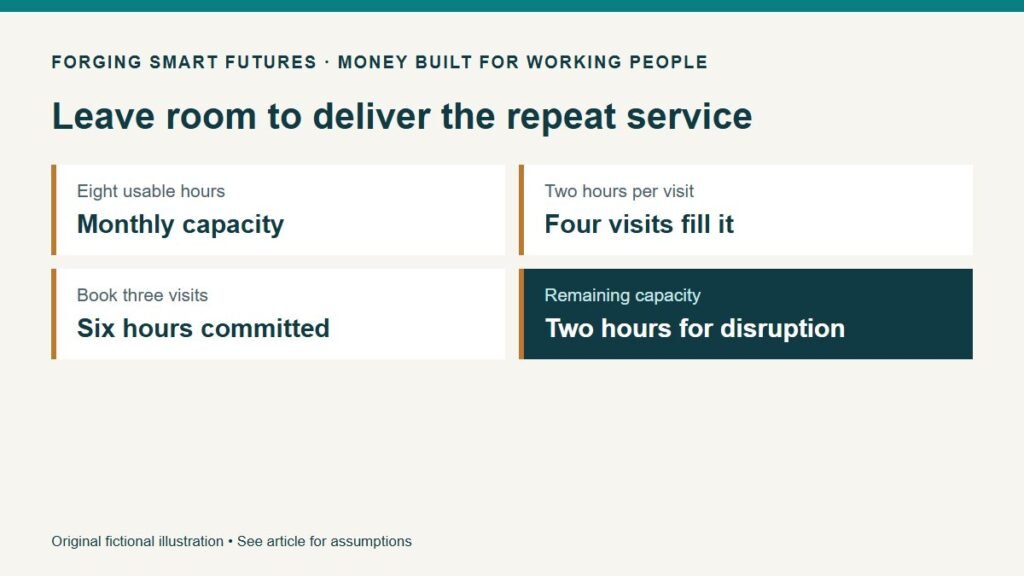
Suppose you have eight usable side-business hours in a typical month and each package needs two hours. Four visits fill the entire allowance. Booking three uses six hours and leaves two for disruption, administration that took longer or a rescheduled visit.
That is a fictional capacity policy, not a universal rule that everyone should reserve exactly one-quarter of their time. Choose your own buffer based on the reliability of your shifts, travel and customer access. Do not sell the buffer twice by assigning it to another commitment.
Make renewal a clear customer decision
For a first repeat offer, a defined next appointment may be easier to manage than an automatic billing arrangement. If using automatic renewal, understand the applicable requirements and clearly explain charges, cancellation and service terms before enrollment. This article does not provide a compliant recurring-billing contract.
After each visit, record what was completed, what was outside scope and the next agreed step. Keep communications useful and limited to the service relationship. Do not add customers to marketing lists just because they bought a job.
Review after several visits
Compare estimated and actual time, costs, payment timing and customer requests. Ask whether the package still solves the intended problem. Update future offers when the facts change, while honoring existing commitments and obtaining agreement for changes where needed.
One satisfied repeat customer is evidence about one relationship. It does not establish that a larger route will have the same travel efficiency or demand.
Your next action
Draft one repeat offer for a real recurring need, then calculate the result with one extra follow-up hour. Check FSF's cash-flow article before relying on future bookings to pay current bills. Available planning resources are labeled on the Resources page.
General education, not individualized business, legal, tax or financial advice. All numerical examples are fictional. No affiliate relationship is presented.
Editorial attribution: Paul Foster
Published: September 10, 2026 Last reviewed: September 10, 2026
Sources & References
- https://www.sba.gov/counseling/plan-your-business/
Put this into practice
Find out what a job earns after costs and all your time. Free Side Income checklist — no membership required.
Related decisions
- Tool Rental or Purchase for a Side Job? Compare the Break-Even Point
- Separate Side-Gig Money From Household Bills Without Building a Complicated System
- Side Businesses You Can Build From Skills You Already Use at Work
Expanded member resource: Side-Gig Profit and Pricing Workbook. Guided exercises with local save, reopen and print controls. Worksheet answers are not automatically calculated. Compare free resources and FSF membership benefits.
Human-reviewed, AI-assisted content; how FSF creates articles.