
Retiring Before Medicare: Put Health Coverage in the Plan
The short answer
Before leaving work, identify the date employer coverage ends, the next coverage start date and the full household cost of the available options. Plan Medicare enrollment separately. Retirement income can look adequate until an omitted health premium or a coverage gap appears.
HealthCare.gov explains that someone retiring before 65 who loses job-based coverage can explore Marketplace coverage and a special enrollment period. Eligibility for financial help depends on the application and circumstances, so use current official estimates rather than a coworker's premium. HealthCare.gov retiree guidance.
Put the dates on one page
Ask the employer when coverage actually ends: the last workday, month-end or another date under the plan. Record any retiree coverage, spouse-plan opportunity or continuation option and the deadlines that apply. Get the effective date of replacement coverage before assuming there is no gap.
Avoid voluntarily canceling existing coverage before understanding enrollment consequences. Losing job-based coverage and choosing to drop retiree coverage are not necessarily treated the same way. The Marketplace guidance above explains that distinction; verify the facts for your enrollment route.
Compare more than the monthly premium
Record the premium after any confirmed assistance, deductible, out-of-pocket maximum, provider network, prescriptions and services important to the household. Check current plan documents and provider participation rather than relying on an old directory or an employer plan's history.
Distinguish predictable costs from exposure if more care is needed. A low premium can accompany substantial costs when services are used. Conversely, adding a deductible to an out-of-pocket maximum as though both are always separate full-year bills can overstate costs; understand what counts toward the maximum and what remains outside it.
Do not treat the out-of-pocket maximum as a cap on every health-related dollar. Premiums and some noncovered or out-of-network costs may not count. Ask the plan to explain the boundaries using your expected care.
Build a bridge-period cash estimate
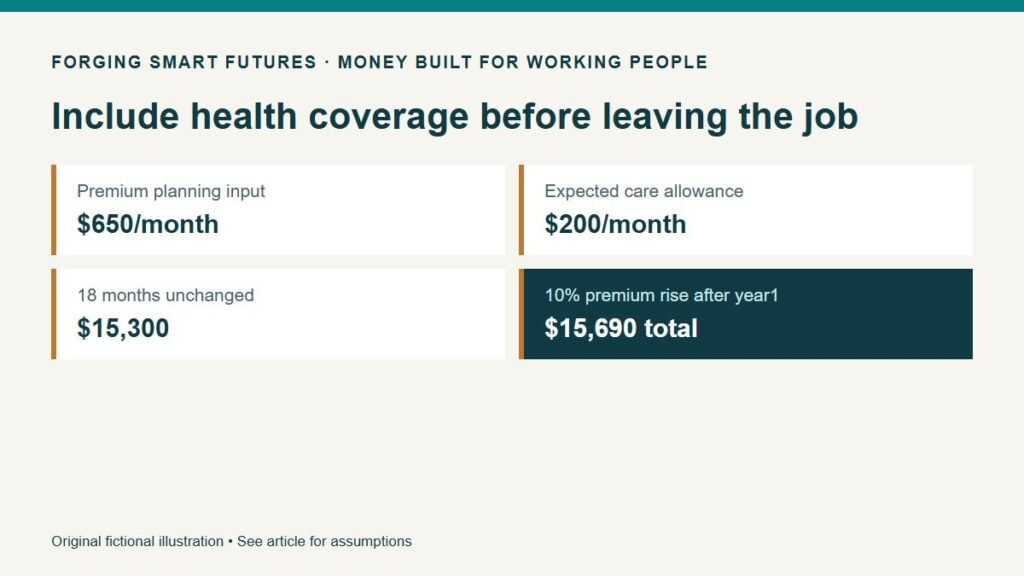
In a fictional example, a household expects eighteen months before its planned Medicare transition. A quoted planning premium is $650 per month and a separate allowance for expected out-of-pocket spending is $200 per month. At unchanged amounts, the $850 monthly total is $15,300 over eighteen months.
If premiums instead rise 10% after the first twelve months, the final six months cost $715 plus the same $200 allowance, or $915 monthly. The total becomes $15,690: twelve times $850 plus six times $915.
Neither figure is a worst-case ceiling or a premium forecast. The allowance may be too small in a high-use year, and plan-year resets can matter. Use the example to keep premium assumptions, expected spending and a higher-cost scenario distinct.
Coordinate income estimates with coverage estimates
Retirement withdrawals, other household income and changes during the year can affect Marketplace calculations. Use the official application's instructions and get qualified tax help where needed. Do not assume a low current paycheck makes every future withdrawal irrelevant to assistance.
Recheck the coverage estimate if the retirement date, household composition or income plan changes. Record whether a quoted premium is preliminary or confirmed and the year to which it applies. An old quote should not silently remain in the budget for a later enrollment year.
Plan the Medicare handoff before the birthday
Medicare's usual initial enrollment period around age 65 spans seven months, and coverage timing depends on when and how you enroll. Different circumstances can affect enrollment rights and penalties. Check the official instructions before relying on current coverage to justify delaying. Medicare coverage-start guidance.
Delaying Social Security does not automatically mean you should delay Medicare. Compare confirmed coverage dates and coordinate ending replacement coverage so you do not create a gap or assume two plans fit together without checking.
Your next action
Collect written coverage-end dates and current plan estimates before committing to a retirement date. Add them to the household cash plan using the FSF budgeting guide. Existing free and member planning resources are labeled on the Resources page.
General education, not individualized insurance, medical, tax or retirement advice. All dollar amounts and premium changes are fictional. No coverage eligibility, subsidy or affiliate relationship is promised.
Editorial attribution: Paul Foster
Published: September 10, 2026 Last reviewed: September 10, 2026
Sources & References
- https://www.healthcare.gov/retirees/
- https://www.medicare.gov/basics/get-started-with-medicare/sign-up/when-does-medicare-coverage-start
Put this into practice
Turn plan documents and old statements into specific next steps. Free Retirement checklist — no membership required.
Related decisions
- Social Security at 62 or Later: Questions for Workers in Physical Jobs
- How to Read Your 401(k) Match When Your Pay Includes Overtime
- Should Your Next Overtime Check Go Toward Debt or Your 401(k)?
Expanded member resource: Workplace Retirement Organizer. Guided exercises with local save, reopen and print controls. Worksheet answers are not automatically calculated. Compare free resources and FSF membership benefits.
Human-reviewed, AI-assisted content; how FSF creates articles.