
Your First Side-Income Recordkeeping System While Working Full Time
The short answer
Keep a record of each sale, each expense and the evidence behind it, then reconcile those records to the money that actually moved. A spreadsheet and organized document folder can be a workable starting point. The test is whether you can explain a transaction later, not whether the software looks impressive.
IRS guidance allows a recordkeeping system suited to the business if it clearly shows income and expenses. Supporting documents matter, including electronic records. IRS business records guidance.
Create a job-to-payment trail
Give each job or sale an identifier. Record the customer reference, work date, amount charged, adjustments, payment date, amount received and payment method. Keep an unpaid amount visible until it is resolved; do not treat an invoice as a bank deposit.
Use customer identifiers rather than unnecessarily copying sensitive information into every worksheet. Keep original documents in a protected location and control who can access them. A backup that can be opened is more useful than an assumption that your phone will never be lost.
For expenses, record date, supplier, amount, business purpose and the receipt or other supporting document location. Mark uncertain treatment for review instead of automatically declaring every purchase deductible. Vehicle and mixed-use expenses need appropriate supporting records; a card statement alone does not explain how much use was business-related.
Reconcile a deposit without losing the fees
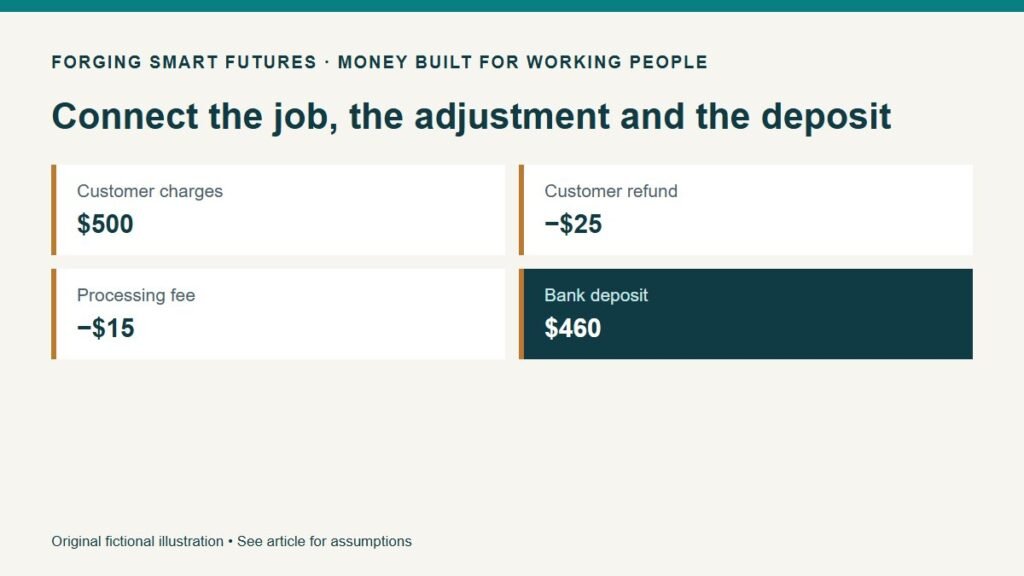
In a fictional week, three jobs produce charges of $150, $225 and $125, for $500 total. A $25 customer refund reduces that to $475. The processor withholds $15 in fees and sends $460 to the bank.
The reconciliation is $500 minus $25 minus $15 equals $460. Recording only $460 as the entire story hides the refund and fee. Recording $500 of receipts and another $460 deposit as new sales counts the same activity twice. Your bookkeeping method and tax reporting need consistent treatment; the reconciliation shows how the source records connect.
Keep the customer invoice, refund evidence, processor statement and bank deposit reference together. If the deposit is $455 instead, investigate the $5 difference. Do not make the worksheet match by inserting an unexplained expense.
Use a short weekly close
Choose a time you can repeat after your normal shift schedule. Collect receipts from your phone, email and glove compartment. Enter transactions that have not synced. Match deposits and withdrawals to the records. Check unpaid invoices and unresolved differences. Back up the updated file and open one saved document to confirm it is readable.
This is a workflow, not a claim that every business can finish bookkeeping in a fixed number of minutes. If transactions accumulate faster than you can review them, simplify the capture method or get help before the backlog becomes a tax-season reconstruction project.
Keep different money movements distinct
Money you contribute from your paycheck is not automatically customer revenue. A transfer between two of your business accounts is not a second sale. A personal withdrawal is not automatically a deductible business expense. Record the purpose so the person preparing the books can apply the correct treatment for your business structure.
The IRS specifically recommends separate business and personal accounts to make records easier and explains that personal expenses generally are not business deductions. IRS income and expense questions.
Make the system handoff-ready
Keep a brief instruction sheet explaining the columns, where documents live, what remains unresolved and when the last reconciliation was completed. Before paying for software or hiring assistance, export a sample month and see whether another person can follow one job through to payment.
Ask your tax professional about record-retention requirements for your circumstances. Avoid a blanket “delete everything after three years” rule; required retention can depend on the record and issue involved.
Your next action
Enter your most recent completed job from beginning to end and reconcile its payment. Then read why a profitable business can still be short of cash to separate earnings from timing. The FSF Resources page identifies available free checklists and expanded member planning resources; a planning tool does not replace your accounting records.
General education, not individualized tax, accounting, legal or financial advice. The example is fictional. No bookkeeping product or affiliate relationship is endorsed.
Editorial attribution: Paul Foster
Published: September 10, 2026 Last reviewed: September 10, 2026
Sources & References
- https://www.irs.gov/businesses/small-businesses-self-employed/what-kind-of-records-should-i-keep
- https://www.irs.gov/faqs/small-business-self-employed-other-business/income-expenses
Put this into practice
Find out what a job earns after costs and all your time. Free Side Income checklist — no membership required.
Related decisions
- Your First Repeat Customer: Turn a Weekend Job Into a Simple Service Package
- Tool Rental or Purchase for a Side Job? Compare the Break-Even Point
- Separate Side-Gig Money From Household Bills Without Building a Complicated System
Expanded member resource: Side-Gig Profit and Pricing Workbook. Guided exercises with local save, reopen and print controls. Worksheet answers are not automatically calculated. Compare free resources and FSF membership benefits.
Human-reviewed, AI-assisted content; how FSF creates articles.