
Starting Retirement Saving at 45 or 55: Build a Plan From Today’s Numbers
The short answer
Start with what you have, what you can contribute on ordinary pay and what income you may have later. Then test changes in saving, spending and work timing. Starting later is a reason to make the assumptions explicit, not a reason to gamble on a promised shortcut.
The Department of Labor's retirement-planning resources provide worksheets and questions for organizing income, savings and expenses. Use them with current account statements and benefit estimates rather than an age-based rule of thumb alone. DOL preparing for retirement.
Build the starting inventory
List retirement accounts, vested workplace benefits, cash reserves, debts and expected pension or Social Security information. Separate a verified current balance from an old statement or an estimate. Avoid counting the same rollover account twice because it has both an old and a new provider name.
Record when each resource could be used and what tax or withdrawal questions remain. Home equity is not the same as cash available for monthly groceries. A pension estimate for a future retirement date is not a payment you receive today.
For Social Security, use your own earnings record and examine the work assumptions behind the estimate. Stopping work earlier than the estimate assumes can change the result. SSA on stopping work and claiming age.
Establish a contribution that fits normal hours
Use regular take-home pay and known expenses before counting overtime. Check your employer match and the cost of capturing it. If contributions are unaffordable while essentials are overdue, address the cash problem rather than setting a rate that will immediately be reversed.
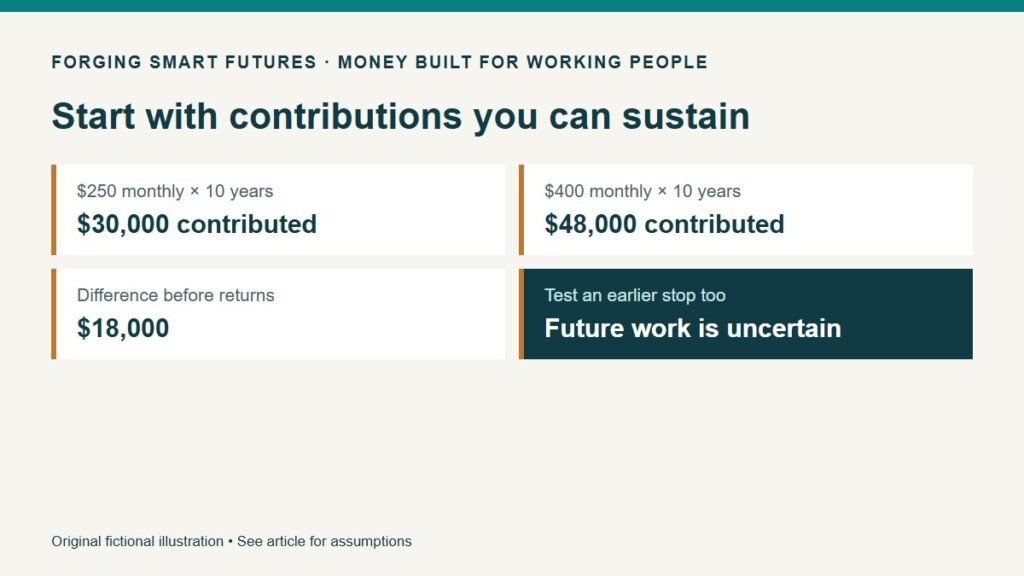
In a fictional example, a worker can sustain $250 per month and expects ten more working years. Contributions alone total $30,000 over 120 months. Raising the amount to $400 adds $150 monthly, or another $18,000 over those ten years, for $48,000 of contributions.
No investment return is assumed in that comparison. It isolates the effect of saving more. Existing balances, fees, gains, losses, taxes and inflation would change the eventual result. A dollar amount ten years from now also may buy less than it does today.
Test several levers without promising miracles
Put each potential change on its own line: contribution increase, employer contribution, lower future expense, later retirement, different work or additional income. Label what is under your control and what depends on health, an employer or market conditions.
Working two more years at $250 per month would add $6,000 in contributions before any returns. It could also change benefit estimates and the period needing retirement funding. But a physically demanding job may not remain feasible, so include a scenario where you stop earlier than planned.
Avoid treating “work longer” as a complete solution. Ask what role, hours and pay would realistically be available, and what happens if the answer is no.
Turn the future budget into a monthly gap
Estimate future essential spending separately from optional spending. Compare it with expected income after relevant deductions and taxes. A fictional $3,000 monthly spending plan against $2,300 of estimated available income leaves a $700 monthly gap, or $8,400 per year.
That gap is a starting question, not a recommendation to withdraw a particular percentage from investments. It helps identify whether saving more, changing expenses, adjusting timing or professional planning deserves attention. Include healthcare and irregular costs so the budget is not artificially small.
Use catch-up rules as capacity, not pressure
Additional contribution room can apply at certain ages, but it does not mean you must contribute the maximum or borrow to do so. The IRS publishes current limits and age-based distinctions, including different catch-up amounts for certain ages. Confirm your plan's implementation and any Roth requirements before changing payroll. IRS 2026 limits.
Your next action
Create the inventory and choose one sustainable change for the next ordinary paycheck. Review the FSF match guide and variable-pay budget. The Resources page identifies available planning tools; none guarantees retirement adequacy.
General education, not individualized retirement, investment or tax advice. Examples are fictional and omit investment returns unless expressly stated. No affiliate relationship or catch-up guarantee is presented.
Editorial attribution: Paul Foster
Published: September 10, 2026 Last reviewed: September 10, 2026
Sources & References
- https://www.dol.gov/agencies/ebsa/workers-and-families/preparing-for-retirement
- https://www.ssa.gov/benefits/retirement/planner/stopwork.html
- https://www.irs.gov/newsroom/401k-limit-increases-to-24500-for-2026-ira-limit-increases-to-7500
Put this into practice
Turn plan documents and old statements into specific next steps. Free Retirement checklist — no membership required.
Related decisions
- A Pension Estimate Is Not a Take-Home Retirement Budget
- Retiring Before Medicare: Put Health Coverage in the Plan
- Social Security at 62 or Later: Questions for Workers in Physical Jobs
Expanded member resource: Workplace Retirement Organizer. Guided exercises with local save, reopen and print controls. Worksheet answers are not automatically calculated. Compare free resources and FSF membership benefits.
Human-reviewed, AI-assisted content; how FSF creates articles.